Trends of Family Life in the United States Essay
The types and distribution of household structures in the United States have been evolving for decades. Consequently, we are now at a tipping signal where our households and our housing inventory take become a round peg struggling to fit in a square hole.
Recent media coverage has presented these changes—such record numbers of adult children living with their parents—as the result of the pressures and preferences of the millennial generation. However, the pass up of two-parent households with children and the rising of other family structures began with the coming of age of the offset baby boomers in the 2d half of the 1960s, and continues today as that generation retires and seeks new living options.
These changes in the organization of American households have primal implications for the real estate industry and policymakers. As households modify, so likewise must industry and public sector leaders by providing a broader range of housing choices that meets new demands—and creates more affordable, stable, and various communities in the procedure.
The trends
Over the by few decades, several significant demographic shifts have inverse how and where Americans live. Merely the nation'south housing supply hasn't kept up with demand.
The so-called "nuclear family" is no longer the dominant household structure.
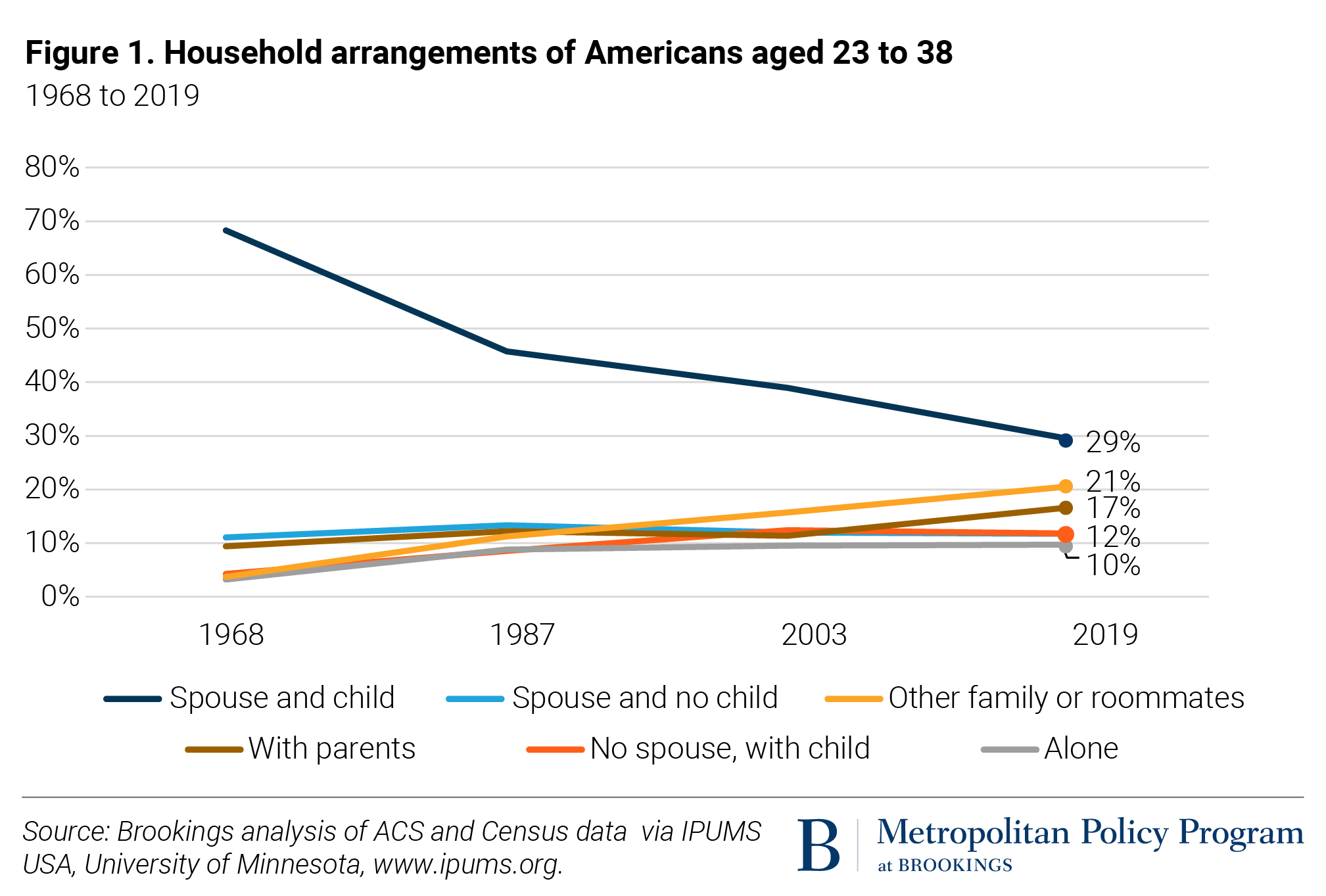
American family life is changing. Marriage rates accept been steadily declining since 1980, and in 2018, the nationwide fertility rate hit an all-time low of 1.73 births per woman. As a result, household structures have shifted dramatically. In 1968, married couples with at least one child comprised about lxx% per centum of all households; by 2018, that share had fallen to less than 30%. At the aforementioned time, fewer than half of U.South. children are growing upwards in households led by ii married parents in their commencement marriage. Single-parent households are now 12% of the total, up from but about 5% in the late 1960s.
Multigenerational and mixed family households take get more common, as Americans are increasingly "doubling up" to reduce housing costs .
While the prevalence of the nuclear family may be shrinking, the size of the average U.Due south. household is actually trending upward for the offset time in over a century. From 1968 to 1987, the share of immature people ages 23 to 38 living alone tripled, then plateaued at x%. Meanwhile, the number of people in this age subclass living with siblings or other family members (i.due east., not a spouse, children, or parents) or with nonrelated individuals grew steadily, rising from five% to 21% of all households by 2019. One of the most significant recent trends has been the ascension share of young adults moving back dwelling house: From 2000 to 2017, the share of nonmarried young adults living with their parents almost doubled, increasing from 12% to 22% due to high housing costs, tight credit, student debt, and other factors.
Our aging population is aging in identify.
With the youngest baby boomers now 56 years old, the American population is aging rapidly. Americans over age 65 make upwardly 16.2% of the full U.Due south. population, up from eleven.5% in 1980. These numbers will continue to rise, such that households headed past someone over age 65 will comprise 34% of all households by 2038, up from 26% in 2018. Moreover, more than than three in four Americans over age fifty express a preference for aging in identify, citing affordability concerns and satisfaction with their electric current neighborhoods. The impacts of COVID-19 on care facilities may very well accelerate that trend.
Housing product beyond U.South. metropolitan areas hasn't kept upward with irresolute demand.
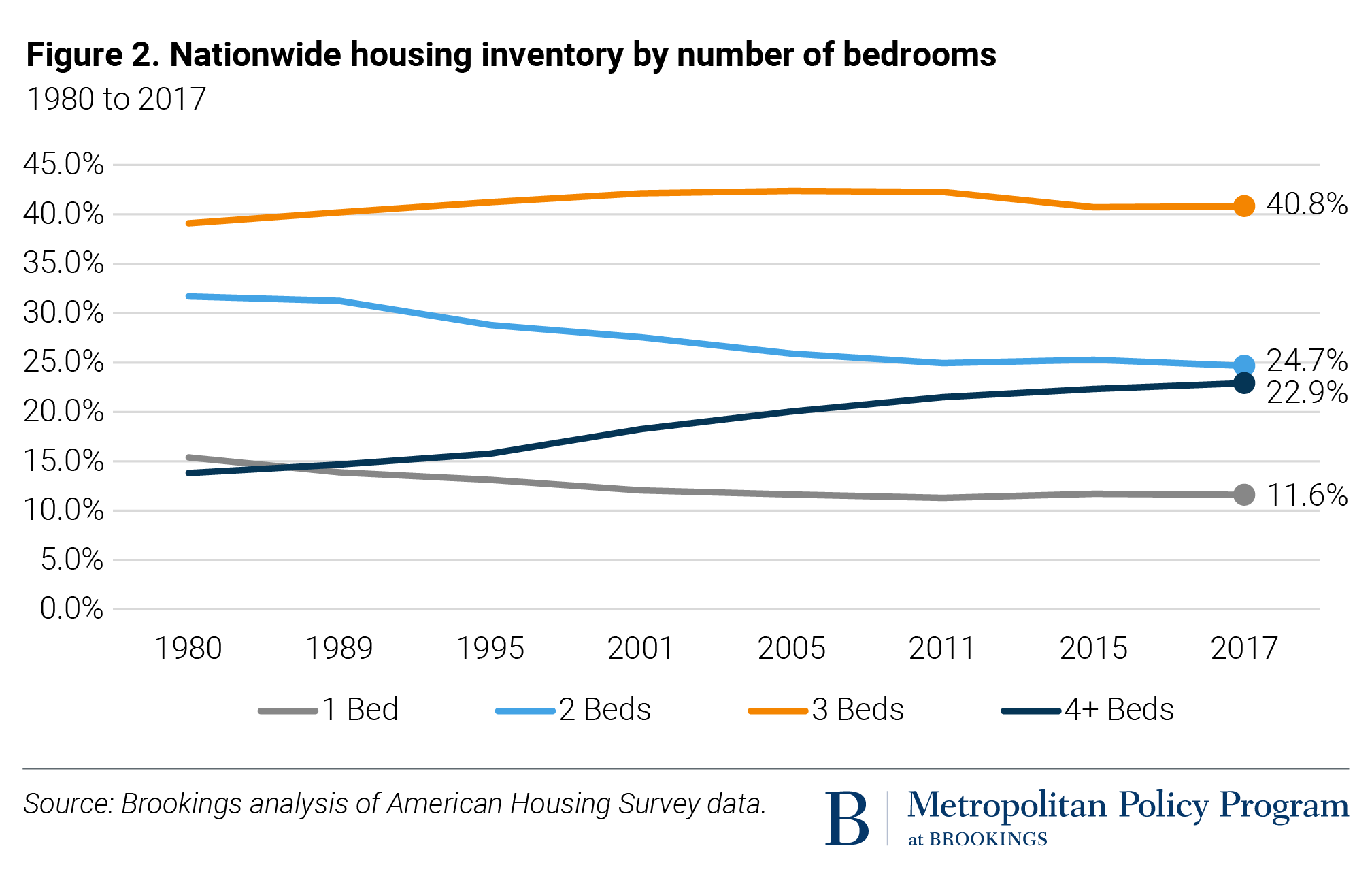
The pass up of nuclear families and the rising of multigenerational or group living arrangements and aging in place are deflating demand for new single-family homes. Yet, the existent estate industry—operating under restrictive zoning compacts—is notwithstanding catering to the traditional nuclear family household by continuing to systematically undersupply minor units (particularly one-bedchamber units) in favor of amalgam large single-family homes. Nationwide, the very largest houses (4 or more than bedrooms) take grown every bit a share of inventory while all smaller configurations have stagnated or declined (Effigy 2).
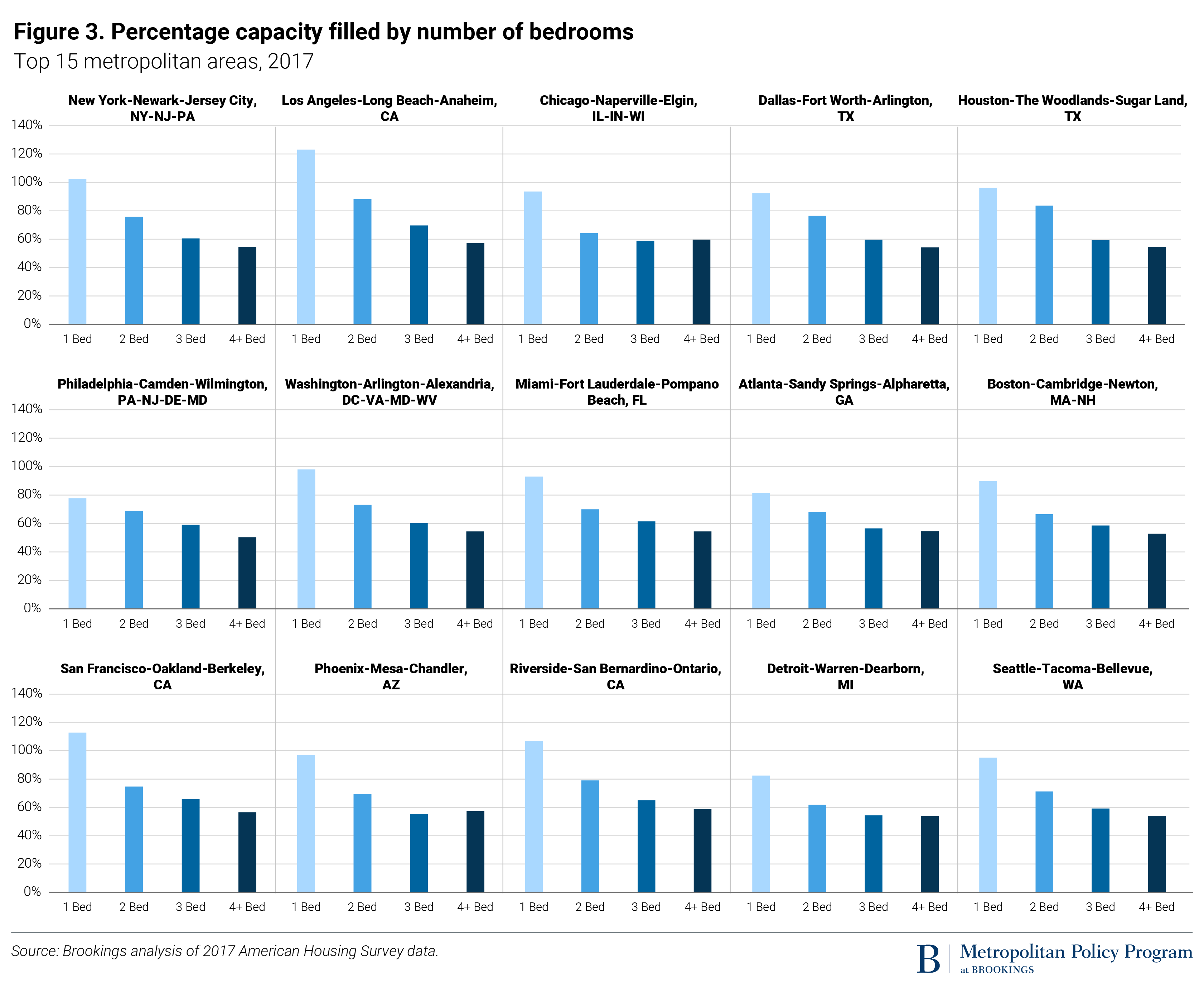
The trends are peculiarly stark in the nation's largest metro areas. Since 2013, units with four or more bedrooms take comprised almost one-half of housing inventory growth on average across the 15 biggest regions, while one-sleeping room units accept accounted for simply 16.7% of such growth (Figure 3). Households in these high-cost, high-growth areas need smaller units. Based on HUD'due south housing unit of measurement capacity standard of 1.five people per bedroom, in all xv of these metro areas, one-bedroom apartments are inside 20% of full capacity on average, while they are over capacity in New York, San Francisco, Los Angeles, and Riverside, Calif. Meanwhile, units with four or more bedrooms in these areas are at just 55% capacity on boilerplate. This means that bedrooms in big houses are sitting empty while households wedge themselves into the smaller units that they can observe—a primal mismatch between the inventory we have and what households demand.
Why these trends matter
Irresolute demographic and household trends warrant transformative shifts in how the real estate industry approaches the supply of new housing. The industry's response to these trends will accept broad implications on housing choice and mobility for both younger and older generations.
Today's under-forty population is a major driver of housing demand, with dissimilar needs and preferences than their predecessors. Millennials—those between the ages of 24 and 39 in 2020—are a market-shaping demographic simply by virtue of the fact that they are the largest generation by population. But for the credit-strapped, newly graduated young adult, buying a single-family unit "starter" home is no longer a financial possibility (nor always an aspiration, for that matter). Even for millennials that can afford to buy a single-family home, homebuying is likely a bad investment, since the current supply of single-family homes does not match the desires nor the arrangements of millennial households.
All this means that while young people boxing over the few available homes that suit their needs and preferences, older adults will be unable to sell their homes to the emerging generation of would-be homeowners. Even putting aside the generational mismatch in preferences and geographic location, the basic math does not bode well for the housing market: Seniors exiting the market will greatly outnumber young homebuyers, leaving fifteen to xviii meg surplus homes on the market place. Most of the homes left will be large-lot, multi-bedroom homes—precisely the type of housing stock that markets in major metropolitan areas continue to oversupply.
Moreover, in predominantly catering to the traditional nuclear family, the real estate industry is continuing to serve the interests of white households over Black and brown households, for whom the suburban unmarried-family home is often more a symbol of profound exclusion than something attainable. Homeownership among Black and Latino or Hispanic households significantly trails that of white households, and people of color are far more than probable to be showtime-time equally opposed to echo homebuyers than white people. In part, this is because a mass of housing inventory weighted against starter homes disproportionately favors households with college concentrations of generational wealth to pay bigger downwardly payments. Over 6 million Blackness and chocolate-brown millennials would be considered mortgage-prepare if there was any accessible production for sale in prime number locations.
In short, the business organisation-as-usual approach to homebuilding has a wide range of negative impacts, enervating that real estate professionals and policymakers comprehend a new framework and vision focused on providing greater housing options both through retrofits to existing priority neighborhoods and through new developments. This framework must include regulatory, finance, and design tools that create more—and more affordable—choices for people of all ages, races, and family unit sizes and mixes.
The authors thank William H. Frey for his helpful review of this piece.
About the Authors

Tracy Hadden Loh
Young man – Anne T. and Robert M. Bass Center for Transformative Placemaking

Evan Farrar
Research Intern – Metropolitan Policy Programme


hutchisonfortaged.blogspot.com
Source: https://www.brookings.edu/essay/trend-2-americas-demographics-are-transforming-but-our-housing-supply-is-not/
0 Response to "Trends of Family Life in the United States Essay"
Post a Comment